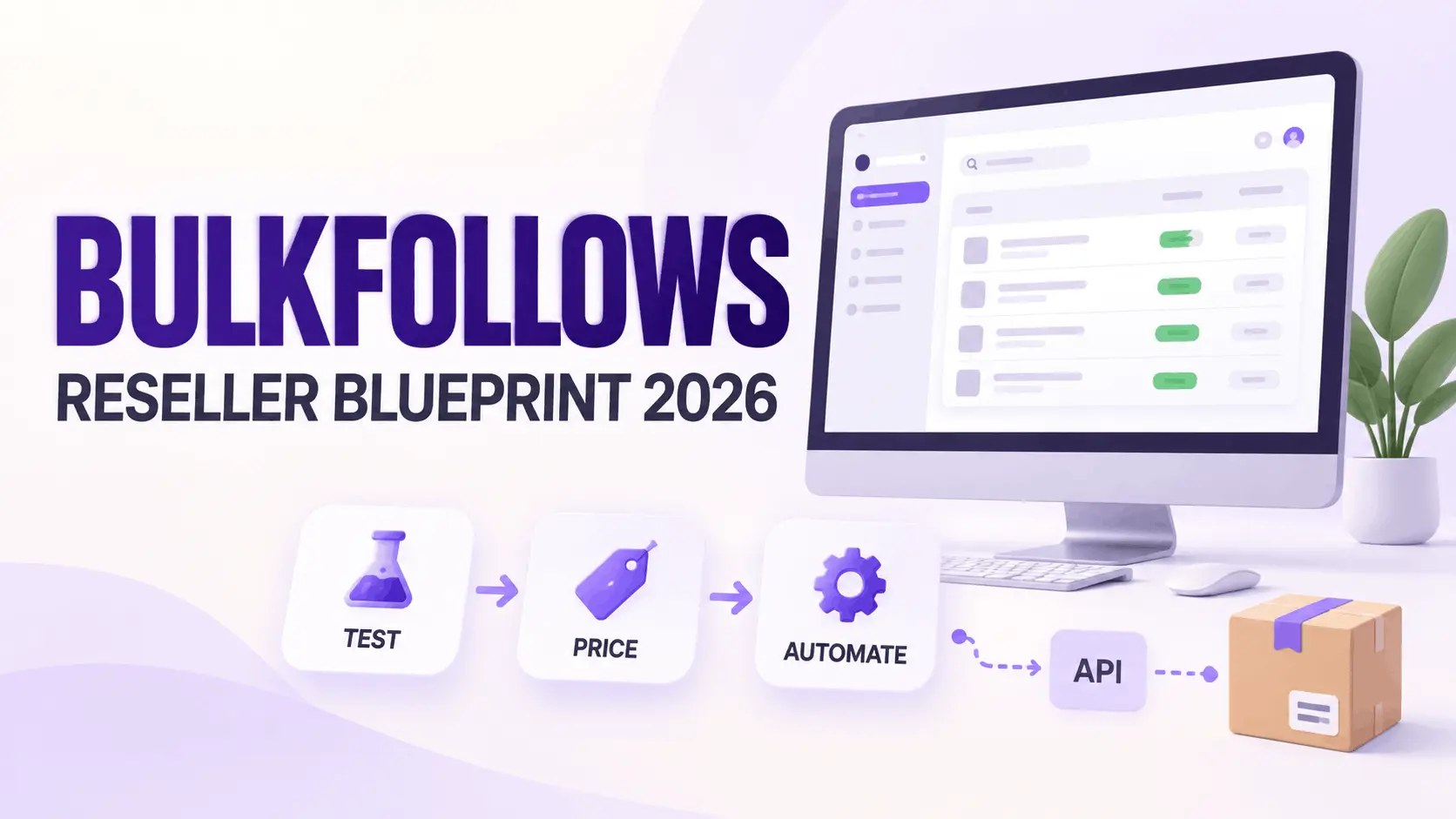
Most articles about SMM providers follow the same formula: list several social networks, repeat a few marketing claims and finish with a generic verdict. That approach does not answer the question a reseller actually has: Can this panel become a dependable part of a working order operation?
This guide looks at BulkFollows from an operational perspective. Instead of treating the platform as a catalogue to browse casually, we will follow the process of turning it into a tested supplier: creating a shortlist, running controlled orders, setting retail prices, connecting the API, monitoring delivery and handling failures without losing customers.
BulkFollows presents itself as a wholesale SMM panel with services for platforms including X, Telegram, LinkedIn, SoundCloud, Snapchat and other networks. Its public pages also promote a reseller API, mass-order tools, a child-panel option, regional payment methods and support through tickets, Telegram and WhatsApp.
Those features create possibilities, but they do not remove the need for testing. Service quality can vary by service ID, delivery estimates can change and social networks can remove artificial engagement. A responsible reseller therefore builds a process around the provider rather than trusting every catalogue entry automatically.
The BulkFollows Reseller Blueprint
A sustainable reseller setup can be divided into six stages. Each stage answers a different business question:
| Stage | Main Question | Expected Result |
|---|---|---|
| 1. Catalogue audit | Which services are worth testing? | A focused shortlist |
| 2. Controlled testing | How do the services perform today? | Documented delivery data |
| 3. Offer design | What should customers actually see? | A curated retail catalogue |
| 4. Pricing | Can the margin cover support and failures? | Profitable retail rates |
| 5. Automation | How can orders run without manual copying? | API-based fulfilment |
| 6. Risk control | What happens when a supplier service fails? | Refund, rerouting and support rules |
Stage One: Audit the Catalogue Before You Deposit
BulkFollows advertises a large catalogue and thousands of active services. The exact number is less useful than the number of services that meet your customers’ needs. A reseller selling Instagram packages does not benefit from importing hundreds of unrelated options for SoundCloud, Telegram or regional platforms.
Begin with three to five categories. For example, an agency might start with Instagram followers and likes, TikTok views, YouTube engagement and Telegram members. Within each category, select no more than three candidate services. This keeps the first test manageable.
Review the following fields for every candidate:
- Service ID and exact name
- Rate and billing unit
- Minimum and maximum quantity
- Required target format
- Estimated start time
- Estimated delivery speed
- Refill period, if any
- Cancellation availability
- Country or account-source information
Do not create retail products from titles alone. Two listings called “Instagram Followers” may have entirely different sources, speeds and retention patterns. The description is part of the product.
Stage Two: Run a Controlled Test Matrix
A single successful order is not enough evidence for a commercial decision. It may have been placed during low demand or on an unusually stable supplier server. A better method is to run the same service at different times and compare it with one or two alternatives.
| Metric | What to Record | Why It Matters |
|---|---|---|
| Pending time | Minutes or hours before processing | Shows queue responsiveness |
| First delivery | Time until the first visible change | Helps create realistic estimates |
| Average speed | Quantity delivered per hour or day | Reveals capacity |
| Completion rate | Completed quantity versus ordered quantity | Identifies partial-order risk |
| Retention | Remaining quantity after 1, 3, 7 and 30 days | Measures stability |
| Refill response | Time and result of a valid refill request | Tests warranty value |
| Support response | Time and usefulness of assistance | Measures operational support |
Use a public test profile that is not mission-critical. Record the starting count with a dated screenshot, submit a small permitted quantity and avoid placing another order on the same target until the first test has finished. BulkFollows’ terms warn against running multiple services simultaneously on one account because doing so prevents accurate delivery tracking and can make an order ineligible for a refund.
The panel also states that orders for private or incorrectly identified accounts are not refundable. Link validation should therefore become part of both your manual and automated workflow.
Stage Three: Turn Supplier Listings into Customer Products
New resellers often import the entire supplier catalogue. This creates a storefront containing thousands of confusing names, repeated options and technical notes written for panel operators rather than retail customers. It also creates support problems when an untested service fails.
A stronger approach is to publish a small, curated menu. Translate supplier language into clear customer-facing products without promising more than the service description supports.
For example, a supplier listing containing an internal server number, estimated start code and refill abbreviation could become a clean product such as “Instagram Followers – Gradual Delivery – 30-Day Refill.” The original provider ID should remain stored internally but does not need to appear in the retail title.
Every retail product should clearly state:
- What public link the customer must provide
- The minimum and maximum order size
- An estimated start window rather than an exact promise
- Whether delivery is gradual or rapid
- The applicable refill period
- Situations that invalidate support, such as a private profile
Keep a hidden backup service for each important retail product. If the primary provider listing becomes disabled, you can pause sales or remap the retail product after testing the backup. Never reroute automatically to a more expensive or lower-quality service without checking the consequences.
Stage Four: Price for the Real Cost of Reselling
Retail price should not be calculated by adding an arbitrary percentage to the supplier rate. The true cost of a reseller order includes payment fees, currency conversion, support time, partial delivery, refunds, failed links, discounts and unused panel balance.
A practical pricing formula is:
Retail Price = Supplier Cost + Payment Cost + Support Reserve + Failure Reserve + ProfitImagine a service costs $1.00 per 1,000 units. A reseller who sells it for $1.10 appears to earn 10%, but one support ticket or payment fee may eliminate the entire margin. A price of $1.80 or $2.00 may be more sustainable, depending on the market and the level of customer service included.
Do not compete only on being the cheapest. Customers also pay for understandable descriptions, local payment options, rapid communication, honest delivery estimates and a reseller who takes responsibility for problems.
Stage Five: Choose Between Manual Ordering, API and a Child Panel
BulkFollows supports different operating models. The appropriate one depends on order volume and technical ability.
| Operating Model | Best For | Main Limitation |
|---|---|---|
| Manual dashboard | Testing and very low daily volume | Copying links becomes slow and error-prone |
| Mass Order | Several standard orders submitted together | Still requires manual preparation |
| API integration | Existing websites and scalable reseller businesses | Needs configuration, logging and monitoring |
| Child panel | Beginners wanting a branded storefront quickly | Less infrastructure control than a custom system |
The public BulkFollows website advertises a free child-panel option. Resellers should confirm eligibility, renewal requirements, domain conditions and included features with support before building a business around that claim. “Free” may describe the basic panel while payment gateways, domain registration, custom development or other operational components can still have separate costs.
How the BulkFollows API Fits into the Workflow
The BulkFollows API is designed to connect an external storefront or compatible panel script to the supplier. According to its official API guide, the integration can retrieve the service catalogue, create orders, check order status, query multiple orders, read the account balance and submit eligible refill requests.
A normal automated flow looks like this:
- A customer chooses a retail product and submits a public link.
- Your system validates the platform, format and quantity.
- The retail product is mapped to a tested BulkFollows service ID.
- Your server sends the provider request using the private API key.
- BulkFollows returns a provider order ID.
- Your database stores both the customer order and provider order ID.
- A scheduled job checks status at controlled intervals.
- The customer dashboard is updated when the status changes.
The API key should exist only on the server. It must never be embedded in front-end JavaScript, mobile application code, public repositories or customer-visible error messages. Anyone who obtains the key may be able to use the account balance.
Build Automation Around Exceptions, Not Only Success
The easiest API demonstration shows a successful order. A real reseller system must also handle incorrect service IDs, invalid links, insufficient funds, disabled listings, partial orders, cancellations and supplier timeouts.
At minimum, maintain the following states in your own database:
- Awaiting payment
- Ready to submit
- Submitted to provider
- Pending
- In progress
- Completed
- Partial
- Canceled
- Requires manual review
Do not mark an order as completed merely because the API accepted it. Acceptance means the supplier created a record, not that delivery finished. Store every request and response with timestamps, but remove or mask sensitive information from logs.
Balance Monitoring Prevents Avoidable Failures
An automated reseller store can accept orders at any hour. If the BulkFollows balance reaches zero, new provider submissions may fail even though customers have already paid your website.
Create two balance thresholds. The warning threshold alerts the operator that funds are running low. The critical threshold temporarily disables affected retail products or routes them for manual review. The threshold should be based on average daily supplier spending, not a random fixed number.
For example, if the store normally uses $50 per day, a $10 warning arrives too late. A safer rule may alert below two or three days of expected cost.
Bulk Ordering Without Creating Bulk Mistakes
Mass ordering is useful for agencies managing many client accounts, but it magnifies data errors. A duplicated line, wrong service ID or misplaced link can create many incorrect orders at once.
Before a bulk submission, run an automated pre-flight check:
- Confirm that every service ID exists in the latest catalogue.
- Verify that each URL belongs to the expected social network.
- Check that the profile or content is publicly accessible.
- Confirm that the quantity fits the service limits.
- Search for another active order on the same target.
- Calculate the total supplier cost and compare it with the balance.
- Require human approval for unusually large batches.
Regional Payments as a Reseller Opportunity
BulkFollows publicly advertises a wide range of payment methods, including cards, cryptocurrency, Payeer and several regional options associated with South Asian markets. Its homepage references methods such as Paytm, JazzCash, EasyPaisa, bKash, Nagad and Rocket.
Availability can depend on account, country and payment-provider conditions, so the dashboard should be treated as the current source of truth. A logo on a marketing page does not guarantee that the gateway will be available to every user.
For resellers targeting India, Pakistan or Bangladesh, local payment acceptance can be commercially important. However, the reseller does not need to copy the supplier’s payment setup. Your customer-facing payment system and supplier funding method can be different as long as cash flow and compliance are managed properly.
Read the Terms More Carefully Than the Homepage
BulkFollows’ public homepage contains strong promotional claims about quality, permanence and authenticity. Its formal terms are more cautious. The terms say delivery times are estimates, prices may change without notice, platform penalties are not the company’s responsibility and services are intended to improve visual appearance rather than replace authentic growth.
For operational planning, the terms should carry more weight than broad marketing language. A reseller should never promise permanent results or guaranteed platform safety when the supplier agreement does not provide that protection.
The terms also state that refill protection does not apply when a page already had 100,000 or more followers, likes or views before the order because losses cannot be attributed accurately. This condition matters when serving large profiles and should be reflected in customer policies.
Refund and Chargeback Planning
BulkFollows states that non-deliverable orders can receive a refund credit to the account balance. Its terms also describe requests for refunds of remaining deposits to the original payment method, subject to processing and payment-provider timing.
Your retail policy should distinguish between a provider balance credit and a cash refund to the end customer. If the supplier returns value to panel balance, you still need enough external cash flow to reimburse a customer who paid by card.
Maintain a reserve instead of withdrawing all customer revenue immediately. This protects the business when several partial orders, cancellations or payment disputes occur together.
A 30-Day Launch Plan
Days 1–3: Research
Create the account, inspect the live catalogue, read the current terms and shortlist no more than fifteen service IDs.
Days 4–10: Testing
Run controlled orders on test targets. Record start time, speed, completion, retention and support behaviour.
Days 11–14: Product Design
Select the strongest services, create clear retail names, write realistic descriptions and define customer eligibility rules.
Days 15–18: Pricing
Calculate payment fees, support reserve, failure reserve and target profit. Avoid margins that collapse after one refund.
Days 19–24: Integration
Connect the API or configure a panel script. Store provider IDs, validate links, add status synchronisation and create error logs.
Days 25–27: Failure Testing
Test invalid links, insufficient balance, disabled services and partial status handling. Confirm that customers receive understandable messages.
Days 28–30: Limited Launch
Release the catalogue to a small customer group, monitor every order and correct problems before increasing advertising or order volume.
Who Is BulkFollows Best Suited For?
BulkFollows may suit resellers who need a broad catalogue, regional payment choices and API-based automation. It can also appeal to beginners who want to experiment with a child panel rather than develop a complete platform immediately.
It is less suitable for operators who expect every service to behave identically, require guaranteed delivery deadlines or do not want to test supplier listings. The terms clearly leave room for changing prices, estimated delivery and platform-related risk.
Questions to Ask Before Scaling
- Which five service IDs have performed consistently across several tests?
- What is the real retention after seven and thirty days?
- How quickly are valid partial and refill cases handled?
- Can the business refund customers even when the supplier returns panel credit?
- Is the API key stored only on the server?
- What happens automatically when supplier balance is insufficient?
- Is there a tested backup for every high-volume product?
- Are retail claims consistent with the supplier’s terms?
Final Assessment
BulkFollows should be evaluated as infrastructure rather than a magic catalogue. Its public offering includes a large selection of social platforms, an API, bulk-order capabilities, reseller positioning, regional payments and a child-panel option. These elements can support a serious operation when they are combined with disciplined testing and monitoring.
The most valuable feature for a growing reseller is not the number displayed beside “services.” It is the ability to select a small set of reliable products, automate them responsibly and respond intelligently when delivery does not follow the ideal path.
A reseller who imports everything, promises permanent results and relies on one supplier without monitoring is building a fragile business. A reseller who tests services, preserves margin, validates links, tracks API responses and maintains backup routes has a much stronger foundation.
BulkFollows can occupy the supplier layer of that foundation, but the quality of the final customer experience will still depend on the reseller’s catalogue choices, pricing, communication and risk controls.

